
Tata Stocks Down from All-Time Highs: A Long-Term Opportunity for Investors?
Stock market corrections often test investor confidence. But for disciplined long-term investors, they can also open the door to opportunity. Some of the most respected companies in India can see steep price declines even when their long-term business potential remains intact. That is exactly why many investors are now paying close attention to Tata stocks down from all-time highs.
The Tata group is one of India’s most trusted business houses, with a strong presence across technology, automobiles, power, chemicals, hospitality, communications, retail, and industrial businesses. When several Tata group companies trade significantly below their peak levels, investors naturally begin asking an important question: Is this a temporary correction, or a long-term opportunity?
At Parasram Holdings, we believe market corrections deserve careful attention, not emotional reactions. Sharp declines do not automatically make a stock attractive, but they can create a good entry point for investors who focus on quality businesses, long-term growth, and disciplined portfolio building. In this article, we look at Tata shares correction trends, the list of Tata stocks that have fallen from all-time highs, and why patient investors may want to keep these companies on their watchlist.
Why Tata Group Stocks Attract Long-Term Investors
There is a reason Tata companies remain popular among investors across market cycles. The Tata brand carries strong trust, long-standing market presence, and diversified exposure to multiple growth sectors of the Indian economy.
-
Brand trust and reputation
The Tata group enjoys one of the strongest reputations in Indian business. Many investors prefer Tata companies because they associate the group with governance, scale, and long-term vision.
-
Diversified business presence
From IT and electric mobility to power, hotels, chemicals, consumer products, and communications, Tata group companies operate across many important sectors. This diversification makes Tata stocks especially attractive for investors looking to spread exposure across industries.
-
Long-term growth potential
Several Tata companies are positioned in sectors with strong long-term tailwinds, including digital transformation, renewable energy, premium consumption, hospitality, and automotive innovation.
-
Strong investor recall
Companies such as TCS, Tata Motors, Tata Power, Trent, Tata Elxsi, Voltas, Indian Hotels, and Tata Communications have attracted both institutional and retail attention due to their strong narratives and sector leadership.
-
Opportunity after corrections
Even excellent businesses go through valuation resets. In many cases, Tata shares below all-time high levels become more interesting for investors who were earlier waiting for better entry points.
16 Tata Stocks That Have Corrected from All-Time Highs
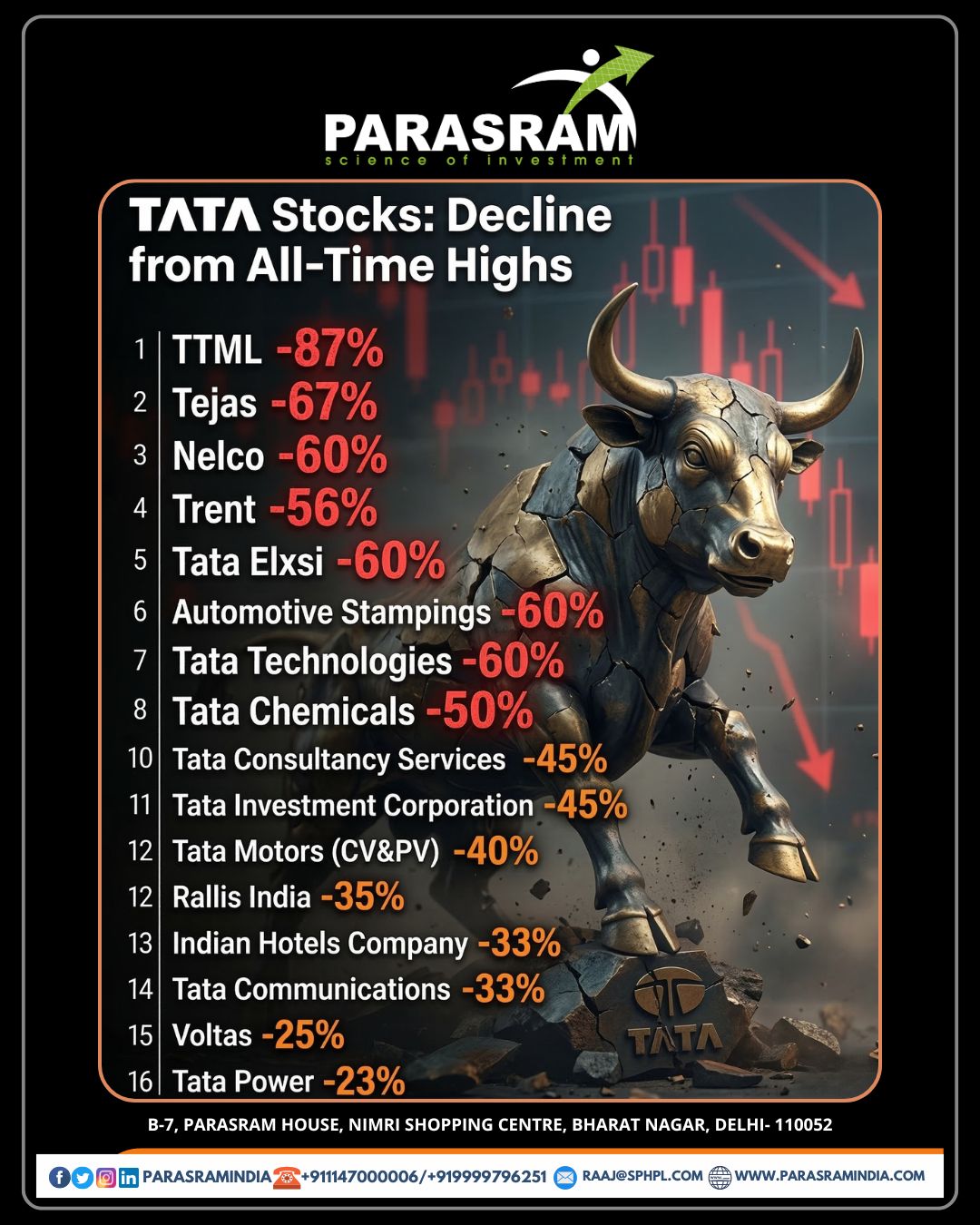
Below is the list of Tata stocks and the extent of their decline from all-time highs:
| Company | Decline from ATH | Sector/Theme | Investor Takeaway |
| Tata Teleservices (Maharashtra) | -87% | Telecom/Enterprise Services | High correction, requires careful risk evaluation |
| Tejas Networks | -67% | Telecom Equipment/Technology | High-growth theme but volatile |
| Nelco | -60% | Satellite Communication/Technology | Niche business, suitable for deep research |
| Trent | -56% | Retail/Consumer | Strong brand-led growth story under correction |
| Tata Elxsi | -60% | Engineering/R&D Technology | Premium business facing valuation reset |
| Automotive Stampings | -60% | Auto Ancillary | Cyclical opportunity with sector dependence |
| Tata Technologies | -60% | Engineering and Digital Services | New-age industrial tech theme under pressure |
| Tata Chemicals | -50% | Chemicals/Specialty Materials | Diversified business with long-term relevance |
| Tata Consultancy Services | -45% | IT Services | Blue-chip technology leader trading below peak |
| Tata Investment Corporation | -45% | Investments/Holding Company | Indirect Tata exposure with valuation angle |
| Tata Motors (CV & PV) | -40% | Automobiles/EV/CV | Major cyclical and structural growth story |
| Rallis India | -35% | Agrochemicals/Agriculture | Sector-linked recovery potential |
| Indian Hotels Company | -33% | Hospitality | Consumption and travel growth story |
| Tata Communications | -33% | Digital Infrastructure/Communications | Enterprise digital theme remains attractive |
| Voltas | -25% | Consumer Durables/AC | Strong consumer brand with cyclical demand drivers |
| Tata Power | -23% | Power/Renewables | Energy transition and utility growth theme |
This list clearly shows that the Tata stocks investment opportunity theme is not limited to one sector. The corrections are spread across retail, technology, power, telecom, hospitality, industrials, and automobiles.
Why Falling Stocks Can Create Opportunity
A large price decline often scares investors, but price and business quality are not always the same thing. A stock may fall sharply for many reasons, including profit booking, expensive valuations, sector slowdown, macro concerns, weaker sentiment, or earnings normalization.
Valuation correction vs business weakness
In bull markets, popular stocks often become expensive. Even a strong company can correct heavily if expectations become too high. In such cases, the decline may reflect a valuation reset rather than permanent business damage.
Market sentiment moves in cycles
Stock markets are driven by both fundamentals and emotions. Fear, caution, and temporary disappointment can push quality names lower. For long-term investors, such phases can create a better risk-reward setup.
Better entry points for patient investors
When investors search for best Tata stocks for long term, they are often looking for quality companies at more reasonable prices. A stock trading well below its peak naturally attracts fresh attention, especially if its long-term growth case remains relevant.
Opportunity requires research
Not every stock that falls is a bargain. Some fall because of real business challenges. That is why investors should focus on revenue visibility, profitability, debt, sector outlook, competitive position, and management quality before investing.
Tata Stocks Long-Term Investors May Watch Closely
While all stocks deserve individual research, some names in this list stand out because of brand strength, business scale, and long-term market relevance.
-
Tata Consultancy Services (TCS)
TCS remains one of India’s most respected IT services companies. It has global operations, strong execution, diversified clients, and consistent profitability. A decline of around 45% from all-time highs naturally attracts long-term investors looking for established large-cap quality.
Why investors track it
- Market-leading IT business
- Strong cash generation
- Consistent long-term wealth creation profile
- Core beneficiary of digital transformation demand
What to monitor
- Global IT spending trends
- Margin movement
- Client deal wins
- Demand recovery in key markets
For investors looking for relatively mature and stable Tata exposure, TCS remains one of the most watched names among Tata group stocks to buy for the long term.
-
Tata Motors
Tata Motors offers exposure to passenger vehicles, commercial vehicles, electric vehicles, and global auto trends. Its 40% decline from the peak could interest investors who believe in India’s mobility story and the company’s improving business mix.
Why investors track it
- Strong domestic vehicle franchise
- EV leadership potential
- Commercial vehicle recovery theme
- Brand strength and scale
What to monitor
- Auto demand cycle
- EV profitability path
- Margins and cash flow
- Competitive pressure
Tata Motors often suits investors willing to handle cyclical volatility in exchange for long-term upside potential.
-
Tata Power
With growing interest in renewable energy, transmission, and power distribution, Tata Power remains a major name in the energy transition narrative. A correction of about 23% from all-time highs is smaller than some others on this list, but still meaningful for long-term investors.
Why investors track it
- Renewable energy growth theme
- Utility-style business visibility
- Long-term relevance in clean energy transition
- Strong retail investor interest
What to monitor
- Execution in clean energy projects
- Debt and capital expenditure
- Regulatory developments
- Profitability across segments
Among undervalued Tata stocks, Tata Power is often discussed because of its combination of legacy utility business and future-focused energy opportunities.
-
Trent
Trent has emerged as one of the strongest consumer-facing Tata stories in recent years. Even after a 56% correction, many investors continue to watch it because premium retail businesses can compound strongly over time.
Why investors track it
- Strong retail growth narrative
- Expansion-led opportunity
- Consumer spending tailwind
- Brand-led scalability
What to monitor
- Same-store growth
- Expansion pace
- Margins
- Valuation comfort after correction
Trent is a reminder that even highly loved growth stories can correct sharply, creating new evaluation opportunities.
-
Tata Elxsi
Tata Elxsi is widely followed for its design, engineering, and technology services capabilities. The stock corrected around 60% from its peak, making it a major case study in premium valuation reset.
Why investors track it
- Specialized engineering and R&D business
- Presence in high-value technology verticals
- Strong long-term structural demand themes
- High-quality market perception
What to monitor
- Revenue growth momentum
- Margin sustainability
- Order pipeline
- Client concentration
For investors comfortable with tech-led business models, Tata Elxsi remains one of the more interesting Tata shares below all-time high.
-
Tata Chemicals
Tata Chemicals offers exposure to chemicals and related industrial themes. With a 50% decline from all-time highs, it has entered the radar of investors seeking diversified industrial businesses.
Why investors track it
- Diversified chemical exposure
- Relevance across industrial use cases
- Well-known Tata group presence
- Potential long-term demand support
What to monitor
- Commodity cycles
- Margin pressure
- Global pricing trends
- Segment performance
-
Indian Hotels Company
As India’s travel, tourism, and premium hospitality story grows, Indian Hotels Company has become one of the most followed Tata consumer names. A 33% correction can make investors reassess its long-term potential more seriously.
Why investors track it
- Strong hospitality brand portfolio
- Premium travel and tourism tailwind
- Rising domestic travel demand
- Asset-light strategy potential
What to monitor
- Occupancy growth
- Room rate trends
- Expansion pipeline
- Consumer demand cycle
-
Tata Communications
Tata Communications is often seen as a digital infrastructure and enterprise communications play. Its 33% fall from all-time highs may interest investors who believe in long-term enterprise digital demand.
Why investors track it
- Enterprise digital infrastructure relevance
- Data, cloud, connectivity, and communications exposure
- Strong strategic business positioning
- Long-term digital economy role
What to monitor
- Enterprise spending
- Growth in digital portfolio
- Margin trends
- Competitive intensity
-
Voltas
Voltas remains a familiar consumer-facing Tata name. With a 25% correction, the stock may appeal to investors who want exposure to India’s rising cooling and consumer durable demand.
Why investors track it
- Strong brand recall
- Consumer durable growth potential
- Seasonal demand opportunities
- Urban consumption theme
What to monitor
- Summer demand patterns
- Margin movement
- Competition
- Consumer spending sentiment
How Investors Should Approach Corrected Tata Shares
Investing in falling stocks requires patience and discipline. Instead of trying to catch the exact bottom, investors may benefit from a structured approach.
-
Build positions gradually
A staggered buying strategy can help reduce timing risk. Instead of investing all at once, investors may accumulate quality Tata names in phases.
-
Focus on business quality
The key is not how much a stock has fallen, but whether the underlying business remains strong, relevant, and capable of growing over time.
-
Diversify across sectors
This list includes IT, power, auto, hospitality, chemicals, retail, and telecom-related names. Diversification can reduce company-specific and sector-specific risk.
-
Match stock choice with risk profile
A large-cap name like TCS may suit conservative investors more than a highly volatile name such as Tata Teleservices or niche technology plays.
-
Keep a long-term horizon
Many of the best Tata stocks for long term may go through volatility before rewarding patient investors. A long horizon can improve decision quality.
-
Study valuation carefully
A stock may be down significantly and still not be cheap. Investors should compare valuations with growth, profitability, and sector outlook.
Risks Investors Should Not Ignore
A balanced investment view is essential. Even if Tata stocks look attractive after correction, investors must remain aware of the risks.
Volatility risk
Corrected stocks can fall further. Market sentiment can remain weak for longer than expected.
Earnings slowdown
If future earnings disappoint, valuation compression can continue.
Sector-specific challenges
Autos, power, telecom, retail, and IT all face different business risks. Investors must study each sector separately.
Macro pressure
Interest rates, inflation, global slowdowns, and demand weakness can affect stock performance.
Overpaying for narratives
Some stocks remain expensive despite falling from all-time highs. A correction alone should never be the only reason to invest.
Company-specific risk
Not all Tata companies have the same business quality, balance sheet strength, or earnings visibility. Each stock needs separate evaluation.
That is why responsible investors should combine optimism with research and discipline.
Why Parasram Holdings Sees Value in Disciplined Investing
At Parasram Holdings, we believe successful investing is not about chasing hype. It is about identifying quality opportunities, understanding business fundamentals, and staying patient through market cycles.
When Tata stocks after market crash or major correction phases come into focus, the right approach is not blind buying. The right approach is thoughtful analysis. Investors should ask:
- Is the business still strong?
- Has valuation become more reasonable?
- Does the sector have long-term growth potential?
- Am I investing with proper risk management?
The Tata group continues to represent many of India’s strongest business themes. That is why corrected Tata shares often become important names on serious investors’ watchlists. For investors looking to understand market trends, sector opportunities, and long-term stock ideas in a more research-oriented way, Parasram Holdings aims to provide insight without unnecessary hype.
To explore more market perspectives and investment-focused content, visit parasramindia.com.
Final Thoughts
The recent Tata shares correction across multiple companies has created a fresh conversation around value, patience, and long-term investing. A stock falling from its all-time high does not automatically make it a bargain, but it can create a more attractive starting point for investors who focus on fundamentals rather than fear.
From TCS and Tata Motors to Tata Power, Trent, Tata Elxsi, Voltas, Indian Hotels, and Tata Communications, several Tata companies remain important businesses with long-term relevance. For disciplined investors, these declines may be worth studying closely.
The most effective strategy is not to chase momentum or panic during corrections. It is to evaluate quality, invest gradually, diversify wisely, and remain patient. In that context, Tata stocks down from all-time highs may offer meaningful watchlist and investment opportunities for long-term investors.
Disclaimer: This article is for educational purposes only and should not be considered investment advice. Investors should do their own research or consult a qualified financial advisor before making any investment decision.
FAQ
-
Are Tata stocks good for long-term investment?
Many Tata group companies are considered attractive for long-term investors because of their brand strength, diversified business presence, and relevance across growth sectors. However, each stock should be evaluated individually.
-
Which Tata stocks are down the most from all-time highs?
Based on the provided list, Tata Teleservices (Maharashtra), Tejas Networks, Tata Elxsi, Nelco, Automotive Stampings, and Tata Technologies are among the biggest losers from their peak levels.
-
Is it a good time to buy Tata shares after correction?
A correction can create opportunity, but investors should not buy based on price decline alone. It is important to study valuations, business quality, sector outlook, and risk factors before investing.
-
Which Tata group stocks are worth tracking now?
Popular names that many investors watch include TCS, Tata Motors, Tata Power, Trent, Tata Elxsi, Tata Chemicals, Indian Hotels, Tata Communications, and Voltas.
-
Why do quality stocks fall from all-time highs?
Quality stocks can fall due to profit booking, expensive valuations, weaker sentiment, sector slowdown, macroeconomic pressure, or temporary earnings disappointment.
-
Are corrected Tata stocks undervalued?
Not always. A stock being down from its peak does not guarantee undervaluation. Investors should compare earnings, growth potential, debt, cash flow, and valuation before making a decision.
-
How should investors approach Tata stocks for long-term investing?
A disciplined approach may include gradual accumulation, diversification, long-term holding, risk management, and regular monitoring of business fundamentals.